
What records do I need to keep for HMRC, and for how long?
Hamster team · Updated · Checked against GOV.UK
The short answer
Keep records of all your side-hustle income and expenses, plus the proof behind them, such as receipts, invoices and bank statements. You must keep them for at least 5 years after the 31 January deadline for that tax year, so records for 2025 to 2026 should be kept until at least the end of January 2032. Even if your income is under the £1,000 trading allowance, GOV.UK says you must keep a record of it.
What to keep
GOV.UK's records guidance says sole traders need records of:
- all sales and income
- all business expenses
- records about your personal income (such as a job)
And the proof behind them, for example:
- receipts for goods and stock
- bank statements
- sales invoices, till rolls and bank slips
For a side hustle, that usually means: platform earnings reports and payout statements, the annual report a platform sends you, invoices or messages showing what customers paid, receipts for stock, materials and equipment, and a log of business miles if you claim them.
You don't send any of this to HMRC with your return. GOV.UK says you keep it so you can work out your profit or loss, and show it to HMRC if asked. Your records must be accurate, and you must be able to tell which transactions are for the business.
Even under £1,000
The trading allowance guidance says that if you use the allowance, you must keep a record of your income. Examples it gives:
- copies of your invoices, paper or electronic
- a spreadsheet of your income receipts
- emails confirming income received
- statements from the company that paid you
- bank statements and pay-in records
- a diary or appointments book showing income from each customer
It also says HMRC can charge a penalty if records aren't accurate, complete and readable, or aren't kept for the required time.
How long to keep them
GOV.UK's rule: keep your records for at least 5 years after the 31 January submission deadline of the tax year they're for. Applying that rule:
| Tax year | Online return deadline | Keep records until at least |
|---|---|---|
| 2023 to 2024 | 31 January 2025 | end of January 2030 |
| 2024 to 2025 | 31 January 2026 | end of January 2031 |
| 2025 to 2026 | 31 January 2027 | end of January 2032 |
| 2026 to 2027 | 31 January 2028 | end of January 2033 |
GOV.UK's own example matches: a 2022 to 2023 return sent online by 31 January 2024 means keeping records until at least the end of January 2029.
Very late returns: if you send a return more than 4 years after its deadline, GOV.UK says to keep the records for 15 months after you send it.
A worked example (invented figures)
Nadia does weekend face painting at parties. For 2025 to 2026 she keeps:
- a spreadsheet of each booking: date, customer and amount (32 bookings, £2,240)
- bank statements showing the transfers, with the face-painting ones highlighted
- receipts for paints, brushes and a public liability policy (£620)
- a note of cash tips (£85)
Her income is £2,240 + £85 = £2,325, so she must be registered. Her £620 of costs are under £1,000, so she claims the trading allowance: profit £1,325. She keeps the whole folder until at least the end of January 2032, because her 2025 to 2026 return was due by 31 January 2027.
If records are lost
GOV.UK says that if you can't replace records that were lost, stolen or destroyed, you must do your best to provide figures, and tell HMRC on your return if you're using estimated figures (your best guess) or provisional figures (temporary ones while you wait for the real numbers, which you then send).
Common mistakes
- Keeping nothing because you're under £1,000. You still need a record of the income.
- Relying on the bank alone. A transfer line doesn't show what a payment was for. Note it.
- Throwing records away after filing. They're needed for at least 5 years after the deadline.
- Mixing in personal transactions without marking them. You must be able to identify business transactions.
- Keeping faded paper receipts only. Records must stay readable, so photograph or scan them.
Keeping them without the shoebox
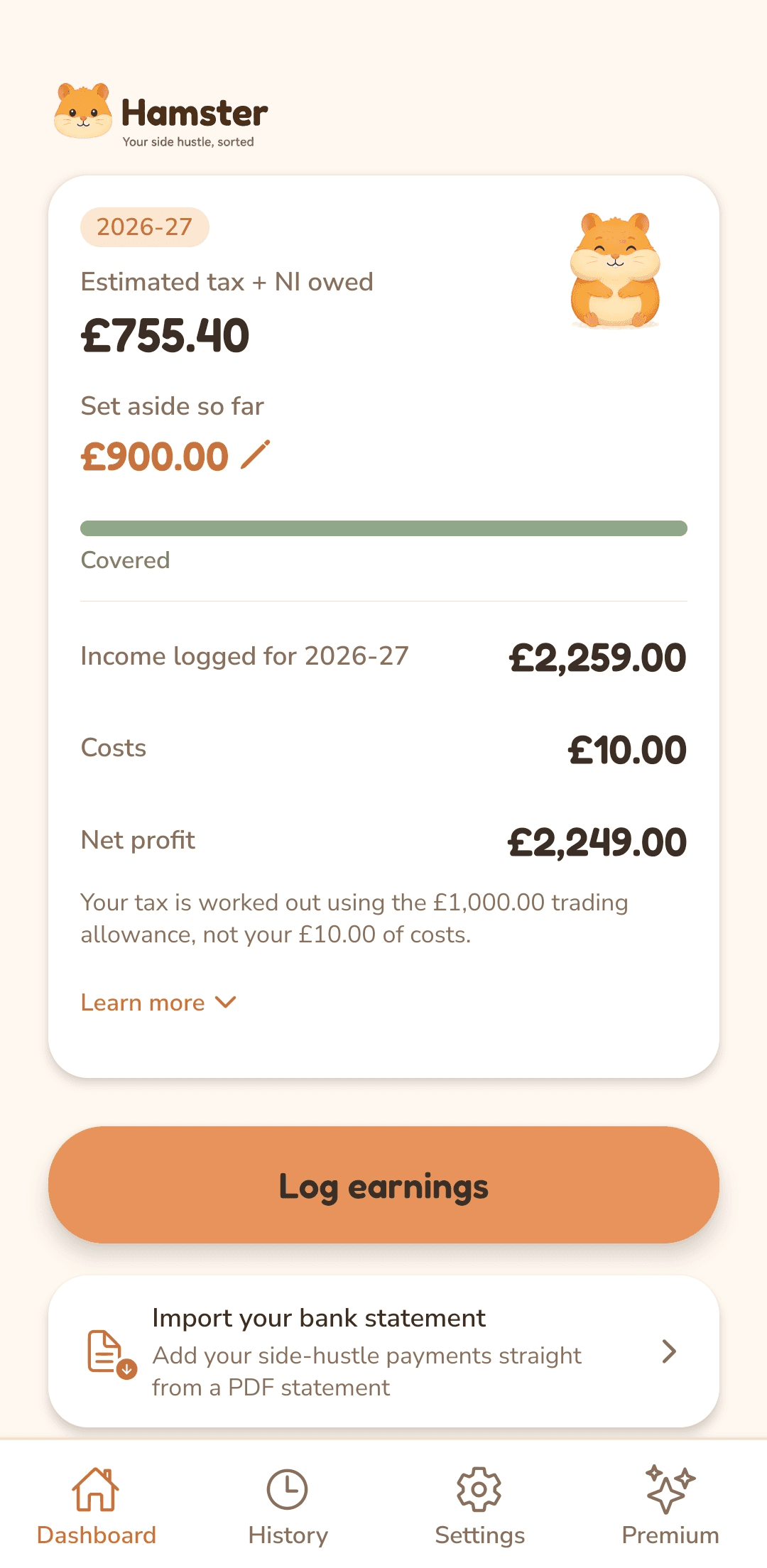
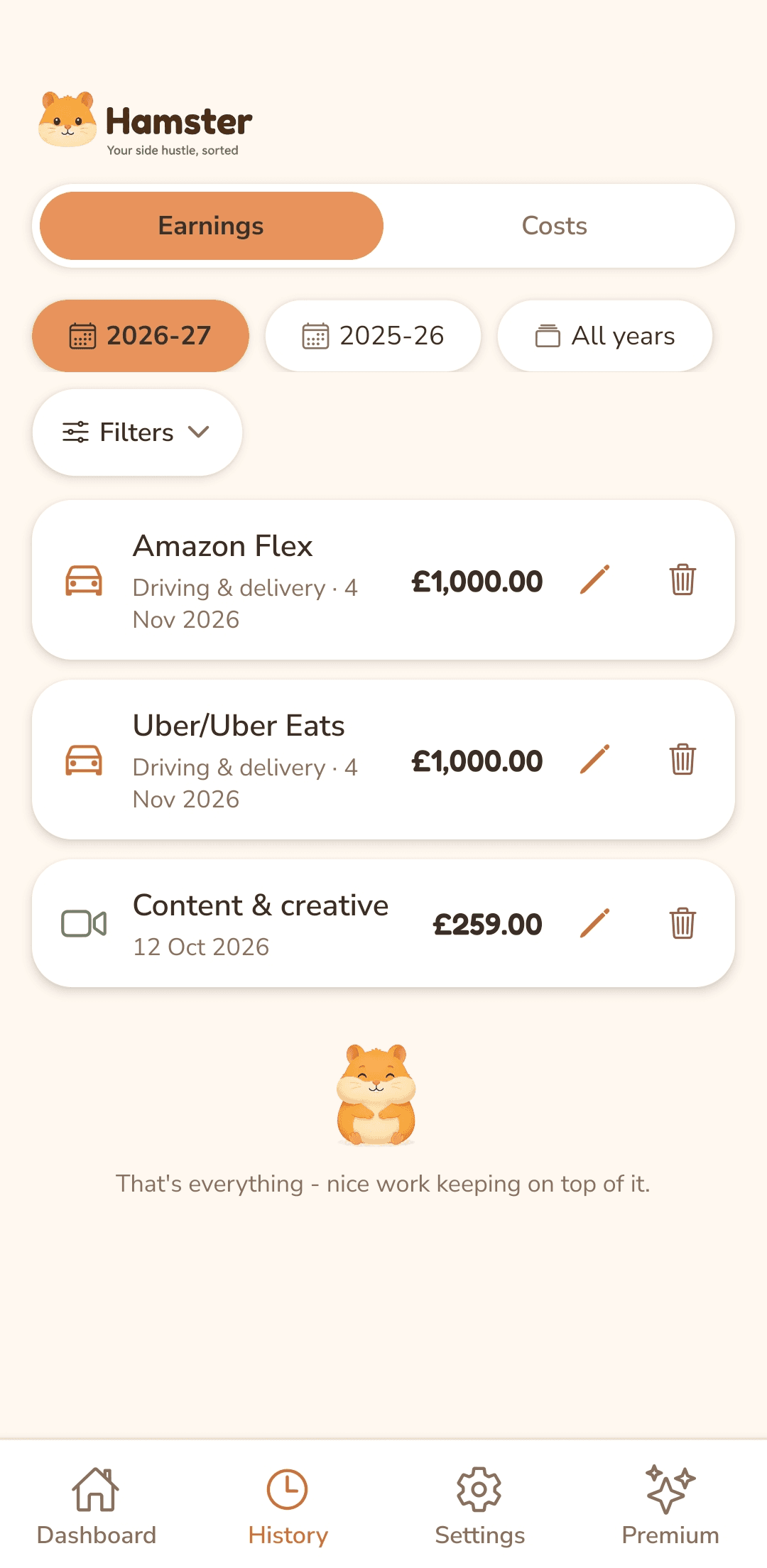
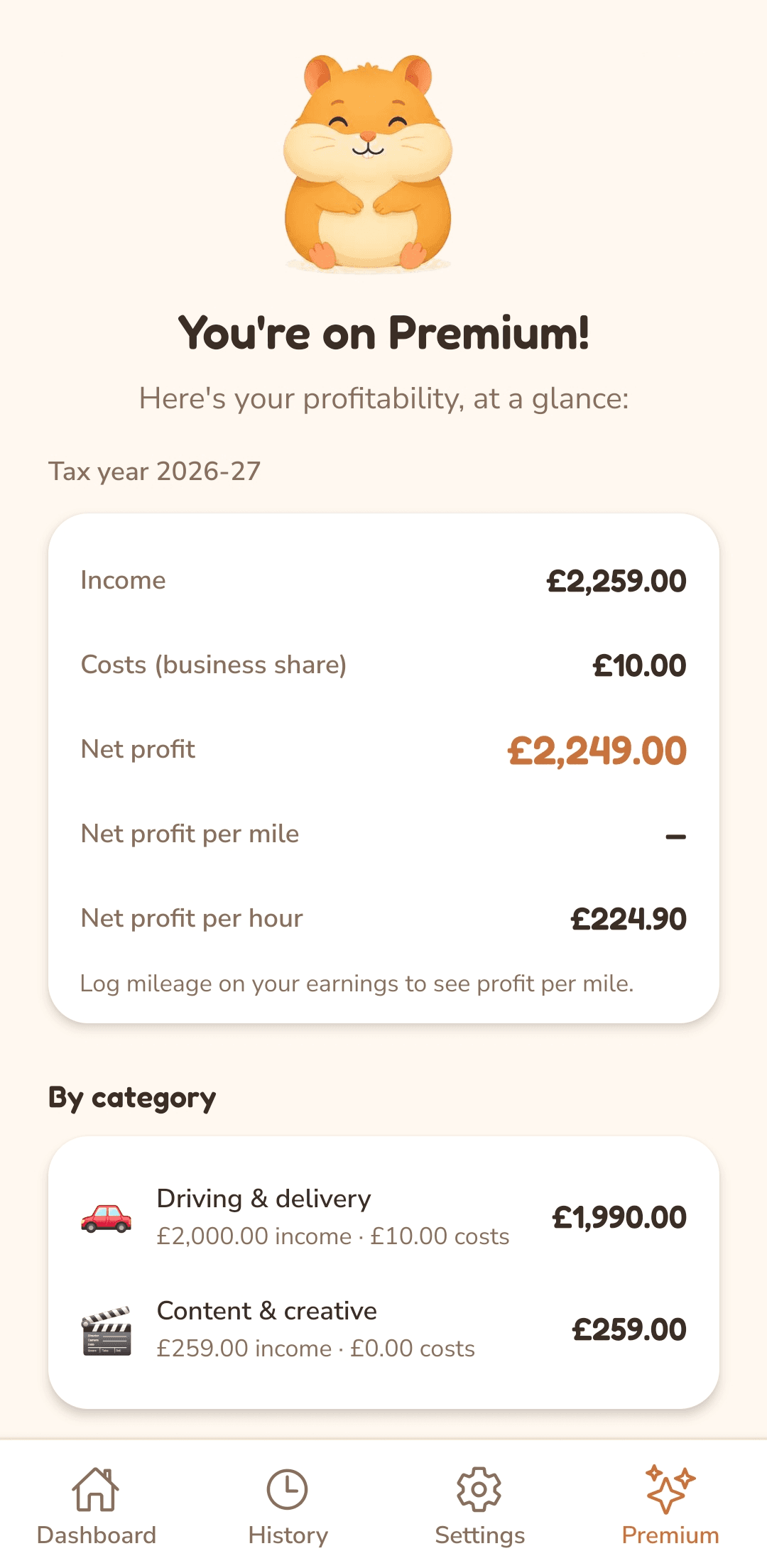
Hamster is a free app for Android and iPhone that keeps your side-hustle income and costs organised by tax year. With Premium you can attach a photo of the receipt to each cost, and use bank statement import to add income from a PDF statement, read on your phone with nothing uploaded, and checked by you before anything is saved.
See it in the app
Dashboard
History
Premium summaryPremium
Quick answers
- How long do I need to keep self-employed records?
- At least 5 years after the 31 January submission deadline of the tax year they're for. For 2025 to 2026, with a deadline of 31 January 2027, that's until at least the end of January 2032.
- Do I need records if I'm under the £1,000 trading allowance?
- Yes. GOV.UK says that if you use the trading or property allowances you must keep a record of your income, such as invoices, a spreadsheet, payment emails or bank statements.
- Do I send my records with my tax return?
- No. GOV.UK says you don't send them in, but you need them to work out your profit and to show HMRC if asked.
- Can my records be digital?
- Yes. GOV.UK's trading allowance guidance lists invoices 'paper or electronic', spreadsheets and emails among the records you can keep, and says records must be accurate, complete and readable.
- What if I've lost my records?
- GOV.UK says that if you can't replace them, you must do your best to provide figures, and tell HMRC when you file whether you've used estimated or provisional figures.
- Is there a penalty for not keeping records?
- GOV.UK says HMRC can charge a penalty if records aren't accurate, complete and readable, or aren't kept for the required time. It also lists failing to keep adequate records as something HMRC may charge a penalty for.
Sources
Last reviewed against GOV.UK. Figures are for the tax year named in each section. Report an error
This is general information, not personal tax advice. Rules and rates change: check the linked GOV.UK pages or speak to an accountant about your own situation.